
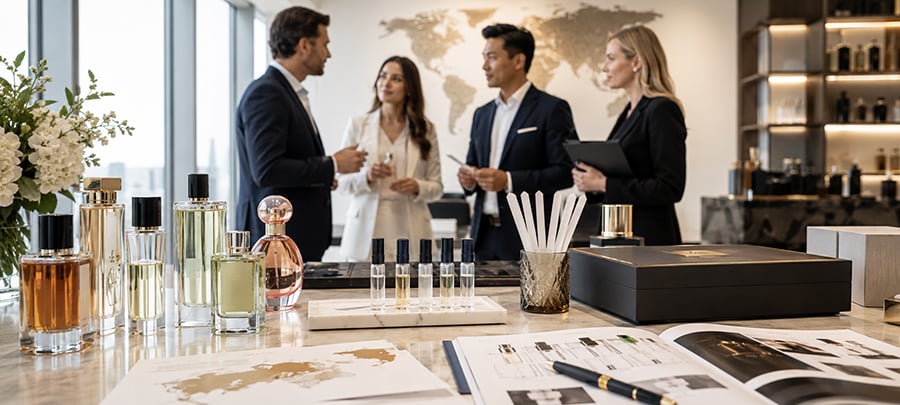
Perfume is emotional. It sells through memory, identity, mood, aspiration and personal taste. But fragrance distribution is commercial. A distributor may love the scent and still say no if the pricing does not work, the brand story is unclear, the packaging is difficult to place, the sample strategy is weak, or the product is not ready for the target market.
This is one of the biggest challenges for perfume and fragrance producers. You are not only selling a smell. You are selling a business opportunity.
The global beauty market continues to create opportunities for fragrance brands. NIQ reported that beauty sales grew by 10% globally over the previous year in its State of Beauty 2025 report, with fragrance identified as the fastest-growing beauty category. The same report also highlighted that online beauty sales are growing nine times faster than in-store sales, which is especially relevant for fragrance discovery, sampling and social commerce.
For scent brands, this creates a strong international opportunity. But it also means competition is intense. Distributors, importers, retailers and online buyers receive many offers from fragrance brands that all claim to be unique.
To stand out, your pitch needs to answer one question clearly:
Why should this distributor believe your fragrance brand can work in their market?
This article explains how perfume and fragrance producers can prepare for international distributor outreach, build a stronger pitch, send samples professionally, avoid common mistakes and use OnCosmetics to find better-fit fragrance buyers.
Why fragrance distributor pitches are different
Pitching a fragrance brand is not the same as pitching skincare, haircare or makeup.
With skincare, a buyer can evaluate product benefits, active ingredients, texture, before-and-after content, clinical positioning and repeat-use routines. With makeup, they can evaluate shade range, packaging, trend fit and visual impact.
Fragrance is more difficult because the product must be experienced.
A buyer cannot fully understand a perfume from a catalog. They need to smell it, test it on skin or blotter, understand the scent story, evaluate packaging, compare price positioning and imagine how the consumer will discover it.
This means your pitch must work in two stages.
First, your email or message must create enough commercial interest for the distributor to request samples or a product deck.
Then, your sample package and follow-up must help the buyer understand the brand, not just the scent.
Many fragrance brands make the mistake of describing only the perfume notes. They write about bergamot, amber, musk, rose, oud, vanilla or sandalwood, but forget to explain the commercial reason why the line belongs in a distributor’s portfolio.
A good distributor pitch must connect the creative side of fragrance with the business side of distribution.
It should explain the scent direction, but also the target consumer, price positioning, channel fit, margin logic, current traction, market readiness and launch support.
Start by defining what kind of fragrance buyer you need
Before searching for perfume and fragrance distributors, define the type of partner you actually need.
Not every fragrance buyer plays the same role.
A fragrance importer may help bring products into a market and manage import documentation, logistics or local requirements. This can be important when a brand is entering a new region for the first time.
A fragrance distributor usually buys products and resells them into retail channels. Depending on the market, this may include perfumeries, department stores, concept stores, independent boutiques, pharmacies, beauty retailers, online shops, salons, spas or professional channels.
A wholesaler may sell perfumes in bulk to smaller stores, resellers, online sellers or regional accounts. This can create sales volume, but it may offer less brand-building support than a specialized distributor.
A retail buyer buys directly for a store, chain, perfumery, online beauty store or specialty retailer. Direct retail conversations can be attractive, but they usually require stronger preparation and local market readiness.
A sales agent or broker may introduce your brand to distributors or retailers, often without buying stock. This can be useful if the agent has strong relationships in your category and target market.
The right partner depends on your brand stage.
A niche extrait de parfum brand may need a selective distributor with relationships in concept stores and niche perfumeries. A body mist brand may need an e-commerce-focused beauty buyer or mass-market distributor. A luxury fragrance house may need a partner with premium retail relationships and strong brand-building capabilities. A clean fragrance brand may need online stores, independent beauty retailers or distributors already working with clean beauty concepts.
A generic list of “perfume distributors” is not enough. You need a list of buyers that match your category, price point, story and sales channel.
Understand where your fragrance brand fits
Before contacting distributors, be honest about your positioning.
Fragrance buyers will quickly try to place your brand in a category. If you cannot define where it belongs, they may struggle to see the opportunity.
Ask yourself:
Is your brand niche, luxury, premium, masstige, mass-market, natural, clean, artisanal, celebrity-driven, fashion-led, wellness-inspired, genderless, travel-friendly, body care adjacent or professional?
Is the line based on fine fragrance, body mists, hair perfumes, perfume oils, solid perfumes, home fragrance, deodorant-style scent products or layered fragrance routines?
Is the product designed for perfumeries, department stores, pharmacies, concept stores, salons, spas, e-commerce, marketplaces, duty-free, hotel retail or gifting?
Who is the target consumer?
Is the brand for fragrance collectors, young social-commerce buyers, luxury consumers, clean beauty shoppers, wellness customers, men’s grooming buyers, Gen Z consumers, niche perfume lovers or gift shoppers?
Distributors need these answers because they must sell your brand to someone else. They need to explain it to retailers, sales teams, store staff, e-commerce teams and sometimes investors or internal category managers.
If your positioning is vague, your distributor pitch becomes difficult to forward internally.
A useful positioning sentence could look like this:
“We are a premium clean fragrance brand focused on modern, genderless eau de parfums for consumers looking for long-lasting scents with transparent ingredients and minimalist packaging.”
Or:
“We are a niche perfume house inspired by Mediterranean botanicals, designed for selective perfumeries and concept stores looking for discovery-led fragrance brands.”
Or:
“We produce affordable body mists and fragrance layering products for online-first beauty retailers targeting younger consumers.”
The clearer your positioning, the easier it becomes to find and pitch the right distributor.
Build your distributor pitch around commercial fit
Many fragrance producers pitch from the inside out.
They start with the founder story, the inspiration behind the scent, the perfumer’s creative process and the emotional meaning of each fragrance.
That information matters, but it should not be the whole pitch.
Distributors think from the outside in. They ask:
Will this brand fit our portfolio?
Can we sell it at the right margin?
Does the packaging match our channel?
Will retailers understand it?
Can consumers discover it easily?
Is the brand prepared for our market?
Will the producer support the launch?
Is there proof that people want this product?
Your pitch should answer these questions quickly.
A strong fragrance distributor pitch usually includes:
- a clear brand positioning,
- product category and concentration,
- target consumer,
- hero scents,
- price positioning,
- retail channel fit,
- market proof,
- compliance readiness,
- sample availability,
- launch support,
- reason for contacting that specific distributor.
For example, instead of writing:
“We make high-quality perfumes with unique ingredients and beautiful packaging.”
Write:
“We are a premium niche fragrance brand with six eau de parfums positioned for selective perfumeries and concept stores. Our best-selling scent already represents 42% of line sales in our home market, and we support distributors with discovery sets, testers, training material, lifestyle content and retailer launch assets.”
The second version gives the distributor something to evaluate.
It turns creativity into a business case.
Prepare your fragrance buyer pack before outreach
A fragrance buyer pack should make your brand easy to understand, evaluate and share.
You do not need to attach every document to the first email. In fact, sending too many files too early can reduce response rates. But once a distributor shows interest, you should be ready to respond quickly.
Your buyer pack should include a concise brand deck. This should explain the brand story, positioning, target consumer, product line, pricing, current markets, sales channels, marketing assets and launch support.
Your product catalog should include each fragrance name, concentration, size, scent family, key notes, short description, recommended retail price, wholesale price, minimum order quantity and available testers or sample formats.
Your sample plan should be clear. For fragrance, samples are not optional. Distributors need to smell the product, test the packaging, understand the atomizer, compare scent evolution and imagine the consumer experience.
Prepare information about:
- discovery sets,
- 1.5 ml or 2 ml vials,
- miniatures,
- testers,
- blotters,
- sample cards,
- travel sizes,
- full-size bottles,
- refill options, if relevant.
Your commercial pack should include wholesale prices, recommended retail prices, margin assumptions, minimum order quantities, lead times, case packs, payment terms and reorder timing.
Your marketing pack should include product images, lifestyle images, founder story, campaign assets, social media content, scent descriptions, training material, store staff education and launch calendar ideas.
Your regulatory and product documentation should be ready for the target market. This may include ingredient lists, allergen information, label files, product safety documentation, certificates, claims support and market-entry notes.
This preparation helps you keep momentum. If a buyer asks for details and you take two weeks to collect the files, the opportunity may cool down.
Be ready for fragrance-specific compliance questions
Fragrance products can raise specific compliance and documentation questions.
In the European Union, cosmetic products must comply with Regulation (EC) No 1223/2009, which the European Commission identifies as the main regulatory framework for finished cosmetic products placed on the EU market. The regulation includes requirements such as a product safety report, an EU Responsible Person and notification through the Cosmetic Product Notification Portal.
This matters for perfume brands because fragrance products sold as cosmetics still need proper safety documentation, label review, ingredient information and market notification where applicable. The EU has also amended its cosmetics framework regarding fragrance allergen labelling through Commission Regulation (EU) 2023/1545, so fragrance brands targeting Europe should review allergen disclosure requirements carefully with qualified specialists.
In the United States, MoCRA has expanded FDA authority over cosmetics. FDA describes MoCRA as the most significant expansion of its cosmetics authority since 1938, and the law establishes requirements including serious adverse event reporting, facility registration, product listing, safety substantiation and future regulations for fragrance allergen labeling.
For international fragrance producers, the commercial lesson is simple: distributors do not want surprises.
They may not expect you to be a regulatory expert in every country, but they do expect you to know what work is required and who will manage it.
Before contacting buyers, clarify:
- Is the product already compliant in the target market?
- Who is the Responsible Person or local responsible party where required?
- Are labels ready or do they need adaptation?
- Are allergens declared correctly for the target market?
- Are claims reviewed?
- Is the product listed or notified where required?
- Are ingredient documents and safety files available?
- Are there any restrictions around shipping alcohol-based fragrance products?
- Who handles import documentation, storage and local registration steps?
This article is not legal advice. For regulatory, safety, customs or labeling requirements, fragrance producers should work with qualified specialists in each target market.
But from a sales perspective, showing that you understand these questions makes your brand much easier for distributors to trust.
Make sampling part of the pitch, not an afterthought
Fragrance distribution depends heavily on sampling.
A buyer may like your deck, but they cannot make a real decision until they experience the scent.
Your sample process should feel professional from the beginning.
Do not send random vials in a plain envelope without context. Treat your sample package as the first physical brand experience.
A strong fragrance sample kit should include:
- a short printed brand introduction,
- sample vials or miniatures,
- scent cards or blotters,
- fragrance descriptions,
- product catalog,
- wholesale and retail pricing,
- bestsellers or recommended launch assortment,
- contact details,
- QR code to digital assets or product videos,
- short explanation of recommended retail channel.
If possible, include a suggested first launch selection. Distributors do not always want to review 40 scents at once. Too many options can slow the decision.
A focused discovery kit with five to eight scents is often easier to evaluate than a full archive.
You can organize the sample kit around:
- bestsellers,
- seasonal fit,
- scent families,
- price tiers,
- target consumer,
- launch priority,
- retailer channel.
For example:
“For your market, we recommend starting with six scents: two fresh, two amber/woody, one floral and one gourmand. These represent our strongest repeat-purchase profiles and give retailers a balanced first assortment.”
This helps the distributor see that you are not just sending perfume. You are proposing a launch strategy.
Explain the scent in a way buyers can sell
Fragrance descriptions can easily become too poetic.
A beautiful description can help the brand, but a distributor also needs practical language that sales teams and retailers can use.
Instead of only saying:
“A sensual journey through moonlit gardens and forbidden memories.”
Add a clearer commercial explanation:
“A warm floral amber fragrance with jasmine, vanilla and soft woods. Best suited for premium evening wear, gifting and consumers who like elegant, long-lasting feminine scents.”
A good fragrance description should include both emotion and clarity.
For each scent, prepare:
- scent family,
- key notes,
- concentration,
- mood,
- target consumer,
- occasion,
- seasonality,
- comparable retail context,
- best channel,
- short sales description,
- long storytelling description.
Distributors need to explain your fragrance quickly. If your scent language is too abstract, it may be difficult for them to train sales teams or create product pages.
For e-commerce, this becomes even more important. Consumers cannot smell through a screen, so your product page must translate scent into understandable expectations.
That means clear copy, strong imagery, note structure, review strategy, discovery sets and sample conversion are essential.
Show proof that consumers want the fragrance
Fragrance is subjective, so proof matters.
Distributors want to know whether your product has already been accepted by consumers, retailers, reviewers or professionals.
Useful proof can include:
- current retail partners,
- online sales performance,
- reorder rates,
- customer reviews,
- press mentions,
- awards,
- influencer content,
- trade show interest,
- bestseller rankings,
- discovery set conversion,
- repeat purchase data,
- strong sell-through in a comparable market.
You do not need to reveal confidential sales data in the first email. But you should be able to provide enough evidence to make the buyer feel that the brand is not untested.
For example:
“Our discovery set has a 28% conversion rate to full-size purchases in our direct-to-consumer channel.”
Or:
“Our hero fragrance is currently sold in 47 independent perfumeries across three markets and has generated repeat orders from 72% of first-year stockists.”
Or:
“The line performed strongly at [trade fair], where we received sample requests from buyers in Germany, France, the UAE and South Korea.”
Specific proof is stronger than broad claims.
“Consumers love it” is weak.
“Our hero scent generates the highest reorder rate in the collection” is stronger.
Build a targeted distributor list
Once your pitch, samples and buyer pack are ready, you can start building your distributor list.
Manual research can help, especially if you look at similar brands and see where they are sold. Review stockist pages, perfumery websites, department store listings, niche fragrance retailers, beauty e-commerce stores, trade fair exhibitors and distributor portfolios.
You can also research competitors by market. If a distributor already works with niche fragrances, clean scents, body mists, luxury perfumes or hair fragrance, they may understand your category.
LinkedIn can help identify buyers, founders, purchasing managers, category managers and business development contacts. But LinkedIn alone is often slow, and job titles do not always show whether the company is a real buyer.
Trade shows can also be useful, especially for fragrance brands, because scent needs to be experienced. But do not wait until the trade show to start outreach. Contact potential buyers before the event, offer a meeting, send a short deck and use the event to deepen conversations.
The key is to build a list based on fit, not volume.
A focused list of 50 relevant fragrance importers, distributors and retailers is more valuable than 500 generic cosmetics companies.
How OnCosmetics helps fragrance brands find better-fit buyers
Finding fragrance distributors manually can take weeks.
You need to identify companies, check whether they work with fragrance, find the right contact person, verify contact details, organize notes and manage follow-up.
OnCosmetics helps beauty producers make this process faster and more focused.
The OnCosmetics platform gives access to constantly updated information about cosmetics product importers, distributors, wholesalers and retailers. It includes more than 57,000 contact persons, 27,000+ companies and coverage across 179 countries. The platform also offers advanced filters that allow users to target companies importing products similar to theirs, including a specific filter for Perfumes & Deodorants.
For perfume and fragrance producers, this means you can search for potential partners by country, company type and product category instead of starting with a generic spreadsheet.
A niche perfume house can look for fragrance-focused buyers in selected markets. A body mist producer can identify beauty retailers and distributors connected to perfumes and deodorants. A brand targeting premium retail can build a shortlist of relevant importers, distributors, wholesalers, retailers and online stores.
OnCosmetics also provides company profiles, verified emails, telephone numbers, social media profiles, address information, Google Map location details, imported product categories and contact management tools. The platform is updated daily, removing dead leads and adding new ones.
This matters because fragrance outreach depends on relevance.
If you contact the wrong buyer, even a beautiful scent may not get a reply. If you contact a distributor that already works with similar products and understands your channel, your chances are much better.
OnCosmetics helps you move from “Who can I contact?” to “Which buyers are most likely to understand this fragrance brand?”
Write a short, specific first email
Your first email should not tell the entire brand story.
It should create interest.
A good first email should be short, relevant and easy to answer.
Use a subject line that tells the buyer what the message is about:
- New niche fragrance brand for your portfolio
- Perfume distribution opportunity for [market]
- Fragrance brand from [country] looking for selected distributors
- Discovery set available: [brand name] eau de parfum line
- Premium fragrance line for [country / channel / category]
Here is a simple structure:
Hello [Name],
I’m [Your Name], [position] at [Brand], a [country]-based fragrance brand specializing in [niche perfume / clean fragrance / body mists / premium eau de parfum / genderless scents].
We are currently looking for selected distribution partners in [market] and noticed that your company works with [relevant category, channel or brand type].
Our collection includes [number] fragrances positioned for [target channel], with [proof point: current markets, best-selling scent, retail partners, awards, reviews, discovery set performance or social traction].
We can provide a short brand deck, wholesale price list, product documentation and a discovery sample kit for review.
Would you be open to evaluating the line for potential distribution?
Best regards,
[Name]
[Title]
[Company]
[Website]
[Phone / WhatsApp]
[LinkedIn]
Personalize the email. A niche perfumery distributor should not receive the same message as a mass beauty wholesaler or online body mist retailer.
The stronger the relevance, the higher the chance of a reply.
Follow up with value, not pressure
Many distributor conversations start after the second or third message.
A buyer may be busy, traveling, attending trade shows, managing launches or waiting for internal review. A polite follow-up process is essential.
Your follow-up should add value. Do not simply write “just checking in” five times.
A good follow-up can include:
- a bestselling scent highlight,
- a sample kit offer,
- a retail fit explanation,
- a market-specific reason for contact,
- a short brand deck,
- a trade show meeting suggestion,
- a new review, award or retailer update.
For example:
Hello [Name],
I wanted to follow up because I believe [Brand] could fit your portfolio of [category/channel]. Our strongest scent, [Fragrance Name], has performed especially well with [target consumer or channel], and we think it could be relevant for [market] retailers looking for [specific opportunity].
I would be happy to send a concise deck or discovery sample kit for review.
Best regards,
[Name]
Follow-up should feel professional, not desperate.
If there is no reply after several attempts, move on and focus on better-fit buyers.
Prepare for the objections fragrance distributors often raise
Fragrance distributors may raise objections even when they like the scent.
That is normal.
If they say the brand is too expensive, do not immediately reduce the price. Ask what price point they are comparing it to and whether the issue is retail price, distributor margin, retailer margin, shipping cost or perceived brand value.
If they say the market is crowded, ask which scent profiles or price points are oversaturated and which ones are still missing from their portfolio.
If they say they already have similar brands, ask what those brands do well and where they see gaps.
If they say they need more marketing support, ask what kind of support matters most: discovery sets, testers, staff training, creator content, PR, retail displays, launch offers or sampling campaigns.
If they ask for exclusivity, clarify the territory, channel, product range, sales targets, order commitments, reporting and review period before agreeing.
If they say the product is not ready for their market, ask what blocks review: label language, allergen disclosure, Responsible Person, registration, documentation, packaging, claims or import process.
The goal is not to win every objection. The goal is to understand whether there is a real path forward.
Be careful with exclusivity
Fragrance brands often feel excited when a distributor asks for exclusivity.
But exclusivity can be risky if granted too early.
A distributor may be strong in niche perfumeries but weak in e-commerce. Another may have online reach but no access to department stores. A third may cover one region well but not the whole country.
Before agreeing to exclusivity, clarify:
- Which territory is included?
- Which channels are included?
- Which products are included?
- What are the minimum purchase commitments?
- What are the launch milestones?
- Which retailers will they approach first?
- How will sales be reported?
- What marketing support will they provide?
- What happens if targets are not met?
- Can they sell on marketplaces?
- Can they discount the brand?
- How can the agreement be terminated?
A safer approach is often to start with a trial period, limited territory, limited channel or non-exclusive agreement.
If performance is strong, the relationship can expand.
For important agreements, work with a qualified legal advisor.
What fragrance distributors want to see before saying yes
A fragrance distributor is more likely to take your brand seriously if you can show five things.
First, they need clear positioning. They should understand what your brand is, who it is for and where it belongs.
Second, they need commercial logic. Pricing, margins, minimum orders, testers, samples and retail price must make sense.
Third, they need sample readiness. A fragrance brand without a professional sample strategy is difficult to sell internationally.
Fourth, they need market readiness. Labels, documentation, allergens, claims and regulatory responsibilities should be clear.
Fifth, they need launch support. Fragrance needs storytelling, education, visuals, discovery and repetition. If the distributor must do everything alone, the brand becomes harder to launch.
The best fragrance pitches combine emotion and execution.
A scent may create the first spark. Preparation turns it into a business opportunity.
Common mistakes when pitching perfume and fragrance distributors
One common mistake is sending a generic email to every cosmetics company. Fragrance requires a specific buyer fit. A skincare distributor may not be interested in perfume, and a fragrance retailer may not work with body mists or deodorants.
Another mistake is overloading the first message with too much storytelling. Your founder story matters, but the first email should quickly explain the business relevance.
Many brands also fail to prepare samples professionally. A distributor should receive a sample kit that helps them understand the line, not a random selection of vials.
Another mistake is using scent descriptions that are too abstract. Poetic language is useful, but buyers also need clear scent family, target consumer, occasion and retail positioning.
Some producers ignore compliance until a buyer asks. This creates delays and can reduce trust.
Others offer exclusivity too early. Do not give away a full country or region without performance commitments.
Finally, many brands stop after one email. International distributor outreach requires structured follow-up.
Final takeaway: sell the business case behind the scent
Perfume is emotional, but fragrance distribution is strategic.
To pitch scent brands internationally, producers need more than a beautiful bottle and an inspiring story. They need clear positioning, a focused buyer list, professional samples, market-ready documentation, realistic pricing, strong follow-up and a pitch that explains why the brand makes sense for that distributor’s portfolio.
The distributor must be able to imagine how the fragrance will sell.
They need to know who will buy it, where it will sit, how it will be sampled, how it will be explained, what margin it will create and how the producer will support the launch.
When you connect creativity with commercial readiness, your fragrance brand becomes easier to evaluate, easier to present and easier to distribute.
Want to find perfume and fragrance distributors that fit your brand? OnCosmetics helps beauty producers discover importers, distributors, wholesalers, retailers and online buyers by country, company type and product category. Request a demo and start building your fragrance buyer shortlist.
FAQ
How do I find perfume and fragrance distributors?
Start by defining your target market, price positioning, fragrance category and ideal sales channel. Then build a shortlist of importers, distributors, wholesalers, retailers and online stores that already work with perfume, deodorants, body mists or related beauty categories. Use competitor research, trade show research, retailer research, LinkedIn and cosmetics-specific buyer databases such as OnCosmetics.
What should I send to a fragrance distributor?
Do not send everything in the first email. Start with a short pitch and offer a brand deck, wholesale price list and discovery sample kit. Once the buyer shows interest, send product documentation, pricing, sample information, marketing assets, scent descriptions, label files and compliance information.
How many fragrances should I include in a sample kit?
A focused selection is usually better than sending too many scents. Many brands start with five to eight fragrances that represent the strongest commercial opportunity: bestsellers, hero products, seasonal scents or a balanced scent-family selection.
What makes a perfume brand attractive to distributors?
Distributors look for clear positioning, strong packaging, memorable scents, realistic pricing, margin potential, proof of demand, professional sampling, market readiness and launch support. They also want to know that the brand can supply consistently and help retailers sell the product.
Do perfume brands need regulatory documentation?
Yes. Requirements vary by market, but fragrance products sold as cosmetics may need safety documentation, ingredient information, allergen disclosure, label review, notification or product listing, and local responsible-party arrangements. Work with qualified regulatory specialists in each target market.
Should I give a perfume distributor exclusivity?
Not too early. Start by clarifying territory, channels, products, purchase commitments, sales targets, reporting and review periods. A trial period, limited channel or limited territory is often safer before granting full exclusivity.
How can OnCosmetics help fragrance brands?
OnCosmetics helps fragrance and beauty producers find importers, distributors, wholesalers, retailers and online buyers by country, company type and product category, including Perfumes & Deodorants. It helps teams build more targeted buyer lists and reduce time wasted on irrelevant contacts.